

Get to know five emerging researchers making a difference in their fields
High-impact, data-driven research has never been more important.
In 2026, many data-driven organizations and professionals are facing changes and challenges. Artificial intelligence (AI) continues to reshape the world of technology, development, and research. The international development sector is busy reshaping itself after a tumultuous 2025. And the U.N. estimates that there are now 305 million people in the world who need humanitarian assistance.
At Dobility (the company that powers SurveyCTO) we’re never been prouder to throw our support behind people working to make a difference against this backdrop of global opportunities and challenges.
We believe in the transformative power of high-quality primary data to inform organizational and governmental decisions for better results and a better world. One way we have shown this support over the years has been through the primary data collection research grant. This grant provides research candidates at global universities with a cash award to offset the costs of fieldwork, and a free SurveyCTO subscription to enable high-quality research.
Each year of the grant inspires us at Team SurveyCTO as we review and select winners from a wider pool of talent. Every year, it seems that applications become more innovative and impressive and represent a wider range of industries, countries, and universities—and that’s our goal. We have also been heartened by the consistent enthusiasm for the grant from the SurveyCTO community, who eagerly boost social posts, attend webinars, and engage with winners in a variety of ways throughout the year and beyond.
Today, we are privileged to once again announce and introduce a new cohort of primary data collection grant awardees. This year’s researchers are creative thinkers and careful investigators engaged in projects designed to reshape healthcare, economics, climate, and agriculture.
Before we dive into each of our winners, here’s a quick snapshot of our 2025 applications, by the numbers:
Total applications: 462
Countries represented: 57
Universities represented: 384
Projects selected for full or partial grants: 5
Projects selected for a free subscription: 15
This year’s research projects are the most diverse yet, from methodology to use of SurveyCTO features to the uniqueness of intended impact. As in the past, selecting this year’s winners from among all applications was hard. We want to extend a heartfelt congratulations to all applicants for the work that has gone into their applications, and their projects. (If you didn’t win this year, be sure to apply next year!)
Below, you can find descriptions and audiograms of the five winners selected from 2025’s applications to receive a full cash grant and free SurveyCTO subscription.
Meet the 2025 winners of the SurveyCTO Primary Data Collection Research Grant
Without further delay, come meet and be inspired by this year’s awardees!
Read to learn a bit about their research, then click the video links to hear each winner describe their project scope and methods in more detail, including how they plan to use SurveyCTO:
Avi Ahuja
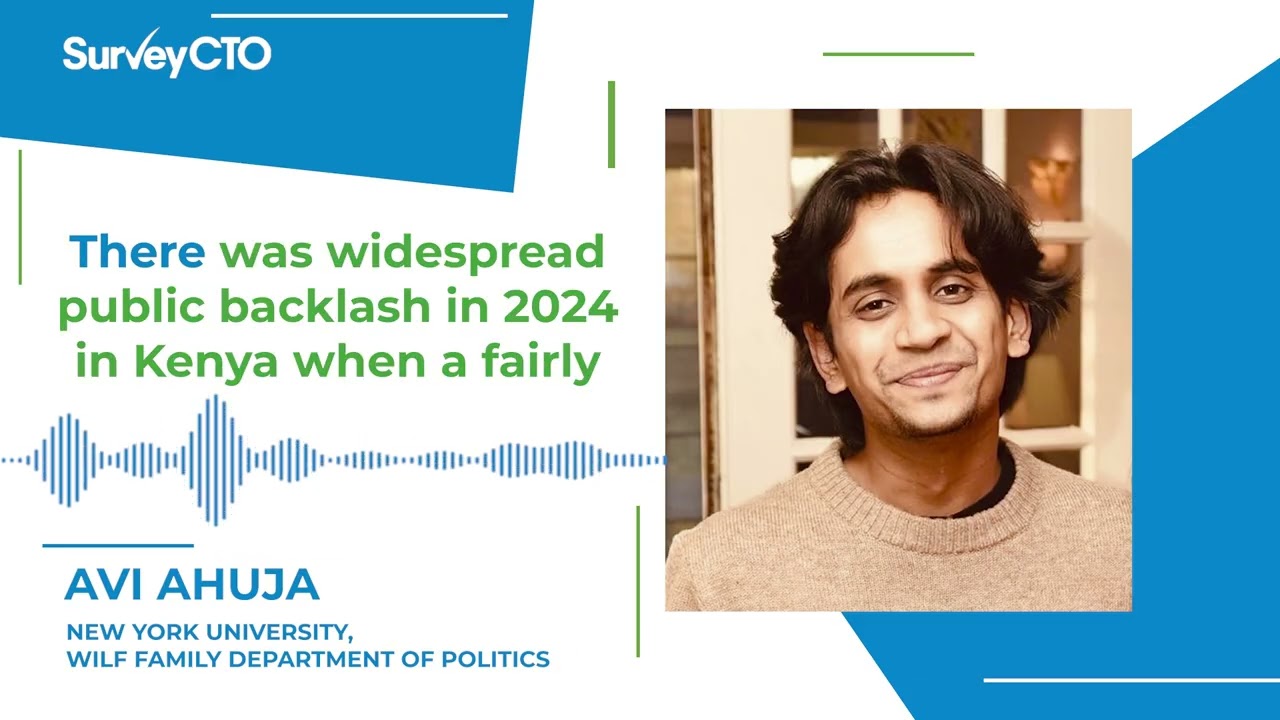
Avi Ahuja, PhD in Political Science at New York University’s Wilf Family Department of Politics.
Project title: Advancing Citizen Engagement in Participatory Budgeting through Fiscal Transparency and Digital Tools in Kenya.
Avi’s project investigates how debt-burdened governments in sub-Saharan Africa can raise domestic revenues while maintaining citizen satisfaction by strengthening the fiscal contract between states and taxpayers. Using a randomized control trial, his research will test three digital interventions: transparency nudges, civic education modules, and feedback/accountability tools to better understand how transparency and digital participatory tools can strengthen fiscal legitimacy in debt-burdened Global South countries.
The impact I’m hoping for is quite practical. I want to provide evidence on how to lower barriers to citizen participation in fiscal policymaking, especially for marginalized groups that are often excluded. So that includes women, informal sector workers, and youth, and how better participation and feedback can strengthen trust and ultimately the fiscal contract. This comes also at a time that is fairly important and critical in Kenya's fiscal trajectory. With foreign aid retrenching and debt servicing costs increasing year on year, the government will need to turn to domestic revenue mobilization to meet its public service obligations.
Avi Ahuja
Muhammed Nurye Gebeyehu

Muhammed Nurye, PhD in Dairy Science and Technology at Haramaya University, School of Animal and Range Science in Haramaya, Ethiopia.
Project title: Estimation of Greenhouse Gas Emissions and Potential Mitigation Strategies in Smallholder Dairy Systems in Eastern Ethiopia.
In this project, Muhammad will study the management techniques used in smallholder dairy systems in Eastern Ethiopia to establish their greenhouse gas emission profile and emission intensity. Building on this initial research, he will then explore the ways to mitigate the climate impact of dairy farming through adoption of improved management strategies like covered storage and anaerobic digestion—a process where microorganisms break down organic materials like manure or food waste within a sealed, oxygen-free container called a “digester.” These strategies can help reduce dairy farmers’ overall emissions and improve the sustainability of this industry.
Through this project, I aim to support the development of climate smart dairy practices in eastern Ethiopia. I will provide farmers, development organizations, and policymakers with reliable data and a realistic pathway to reduce emission without compromising the productivity and environmental challenge of the dairy system.
Muhammed Nurye
Dorah Kwamboka Momanyi

Dorah Kwamboka Momanyi, PhD in Climate Change and Adaptation at The University of Nairobi in Kenya.
Project title: Quantifying the Contribution of Agroforestry Systems to Food and Nutrition Security and Local Incomes among households in Buffer Zone Around Mt. Kenya Forest.
Dorah’s project explores the link between biodiversity, nutrition, and policy, and how the right agroforestry policy can both positively impact local people and the environment at the same time.
Through the creation of a plant diversity index and spatial map, Dorah will provide critical data for better, nature-based agroforestry policy that increases conservation while promoting nutrition security and local livelihoods to benefit smallholder farmers in Kenya.
I am super excited to contribute to the growing science that is providing evidence on the actual impact of agroforestry to communities, amplifying its drivers thereof. I want to see the community in Laikipia and Meru countries of Kenya finally appreciate the need to add trees on their crop farming systems and enjoy the ecosystem services, economic, environmental, and social benefits of living near the protected Mount Kenya forests.
Dorah Kwamboka Momanyi
Simon Birk

Simon Birk, MD in Global Health at UTHealth Houston McGovern Medical School.
Project title: Schistosomiasis Control from a One Health Perspective (SCOPE) Study: Evaluating the efficacy of ultra-low-cost microscopy and a novel filtration device for schistosomiasis diagnostics in rural Nigeria.
Simon’s project, The SCOPE Study, is led by Health in Your Hands Diagnostics (HIYH), a student-led international research collaborative and 501(c)(3) non-profit using low-cost innovation to address pressing global health challenges.
The SCOPE study aims to develop new means of combatting schistosomiasis, a tropical disease transmitted through contact with freshwater infested by contaminated snails, through a toolkit designed for community health workers (CHWs) that includes a low-cost microscope and filtration device allowing for on-the-ground testing. The project will also evaluate not only the effectiveness of the toolkit, but also its cultural competency and suitability.
The biggest impact we're trying to make with this work is at its core a dent in the inequality of the world. We have a problem with clearly defined parameters and a lot of technology today that can be used to alleviate it, and we do the best with what we've got. But I think what my team is trying to do is produce options for the people affected by [schistosomiasis]. If we can create and validate a low-cost microscopy screening toolkit, we can place the power back in the hands of the people affected by this disease.
Simon Birk
Vrinda Sharma

Vrinda Sharma, PhD in Economics at Paris School of Economics.
Project title: Enabling Access to safe drinking water – Evidence from Gujarat.
Vrinda’s project studies an intervention for the lack of access to clean drinking water in rural India: reverse osmosis (RO) plants, which use high-pressure pumps to force water through semi-permeable membranes that remove contaminants and saline. Despite their effectiveness, RO’s are often underutilized. In this project, Vrinda undertakes field research to ask: What is the impact of community RO access on household health and time use, with secondary outcomes including water security and social integration? And, why is take-up low, and what interventions can effectively increase adoption, particularly among poorer households?
Our research studies the expansion of community reverse osmosis plants in villages in Gujarat. These plants treat both biological and chemical contamination, including high salinity, but adoption among households has been surprisingly low. We want to understand why takeup is low, who benefits, and what interventions like pricing, information, or social learning can increase adoption, especially among poorer households. This is very crucial since climate change is impacting both water quantity and quality, and we have very little evidence on how households learn and adopt new technologies that can help in creating future resilience.
Vrinda Sharma
Honorable mentions
In addition to the cash grants and free subscriptions, we also awarded free subscriptions to the following applicants:
- Bright Olunusi from Cornell University
- Dario De Quarti from Geneva Graduate Institute – Department of Economics
- Irene Furlani from the University of Passau
- Madhavi Jha from Harvard University
- Mitali Mathur from the University of California, Davis
- Ny Aina Ianjatina Andrianony from KDI School of Public Policy and Management
- Oluwatobiloba Ajayi from the University of Toronto
- Saheel Chodavadia from the University of Michigan, Department of Economics + Ford School of Public Policy
- Samuel Kusheta from the School of Public Health, Addis Ababa University
- Saviour Tepson Tepe from the University of Ghana
- Simoni Jain from the Haas School of Business at the University of California, Berkeley
- Thomas Buyinza from Makerere University
- Wade Lahring from the University of Calgary
- Wongibe Poupezo Dieudonne from The University of Bamenda, College of Technology
- Yuki Kanayama from the Graduate School of Economics, Keio University
Stay in touch to learn more about these winning projects
Entering its sixth year, the SurveyCTO Primary Data Collection Research Grant continues to inspire us here at Dobility. We’re honored to further these up-and-coming researchers’ impact not only through our grant but by engaging with them throughout the year.
Follow the journeys of the 2025 cohort to learn more about their research! Follow SurveyCTO on LinkedIn, and subscribe to our newsletter through the button on the right. We’ll be sharing more about the grant winners in the coming weeks and months.


